Fecal Egg Count Testing for Horses: What Owners Should Know
Learn what fecal egg count (FEC) testing is, why it's the foundation of modern equine parasite management, how it works, and what the results mean for your horse's deworming plan.
QZQAB Editorial Team
Equine Health Content Specialists
Important Safety Information
This article is for educational purposes only. It does not constitute veterinary advice. Always consult a licensed veterinarian for guidance specific to your horse.
What Is a Fecal Egg Count?
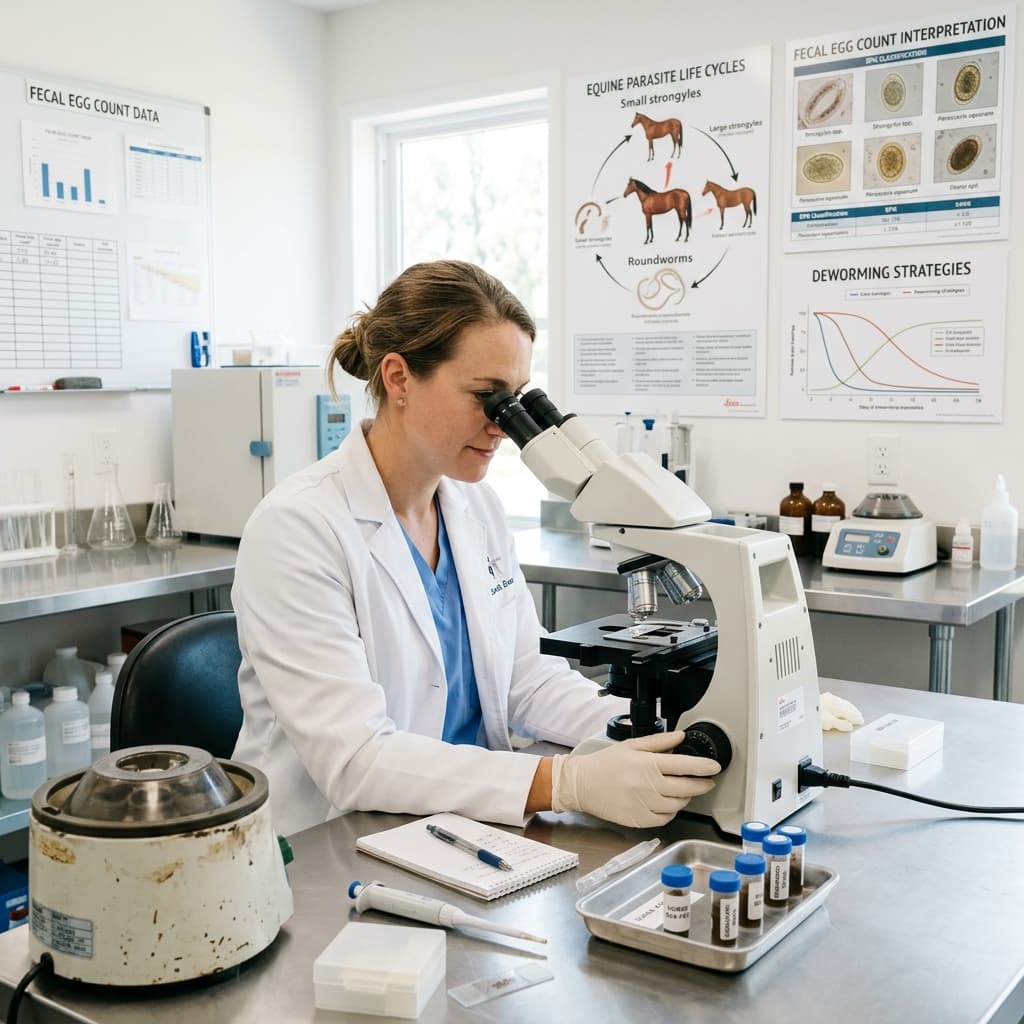
A fecal egg count (FEC) is a diagnostic test performed on a horse's manure sample to identify and quantify the eggs of internal parasites. The test provides objective, measurable data about what parasites your horse is shedding and at what levels — information that is essential for making informed deworming decisions.
FEC testing is the foundation of modern, evidence-based equine parasite management. The American Association of Equine Practitioners (AAEP) recommends FEC-based programs over the traditional calendar-based deworming approach that dominated equine care for decades.
Why FEC Testing Matters
The Problem with Calendar-Based Deworming
For many years, the standard practice was to deworm every horse on a fixed schedule — typically every 6-8 weeks — regardless of actual parasite burden. This approach has significant drawbacks:
- Unnecessary treatments — Many horses have naturally low parasite burdens and do not need frequent deworming
- Accelerated resistance — Frequent, blanket deworming contributes to parasite resistance, reducing the effectiveness of the limited drug classes available
- Wasted money — Treating horses that don't need treatment is an unnecessary expense
- False confidence — Deworming on schedule does not guarantee that the chosen product is actually effective against the parasites present
The FEC Advantage
FEC testing addresses all of these problems by providing objective data:
| Calendar-Based Approach | FEC-Based Approach |
|---|---|
| Treats all horses the same | Treats based on individual need |
| Contributes to resistance | Minimizes unnecessary treatments |
| No verification of effectiveness | Enables post-treatment verification |
| Higher lifetime dewormer use | Targeted, efficient dewormer use |
| No insight into parasite burden | Quantifies actual egg shedding |
For more on why veterinary guidance should drive deworming decisions, see our article on deworming schedule consultation.
How FEC Testing Works
Sample Collection
Your veterinarian will instruct you on how to collect a fresh manure sample. Key principles:
- Fresh is essential — collect from a manure pile that was deposited within the last few hours
- Avoid contaminated samples — do not collect from old piles, wet ground, or areas heavily soiled by other horses
- Proper container — use a clean, sealable container or bag
- Label clearly — note the horse's name, date, and time of collection
- Deliver promptly — samples should be examined or refrigerated within hours
Laboratory Analysis
The most common FEC technique used in equine practice is the McMaster method or a modified version. The basic process involves:
- A measured amount of manure is mixed with a flotation solution
- The mixture is placed in a specialized counting chamber
- Parasite eggs float to the surface
- Eggs are identified and counted under a microscope
- The count is expressed as eggs per gram (EPG) of manure
Interpreting Results
FEC results are typically categorized:
| EPG Range | Classification | Typical Recommendation |
|---|---|---|
| 0-200 EPG | Low shedder | May not need deworming at this time |
| 200-500 EPG | Moderate shedder | Discuss treatment with your vet |
| 500+ EPG | High shedder | Treatment typically recommended |
Important: These ranges are general guidelines. Your veterinarian will interpret results in the context of your horse's age, health, management, and local parasite conditions. A high count in a young horse may warrant different action than the same count in an adult horse.
What FEC Can and Cannot Tell You
FEC can:
- Quantify strongyle egg shedding
- Identify roundworm eggs (important in young horses)
- Help classify your horse as a low, moderate, or high shedder
- Track changes over time
- Verify treatment effectiveness (via FECRT)
FEC limitations:
- Does not detect encysted small strongyle larvae
- Does not provide reliable tapeworm detection (a different test is needed)
- Egg counts vary by time of day, sample freshness, and technique
- A single test is a snapshot — trends over time are more informative
The Fecal Egg Count Reduction Test (FECRT)
The FECRT is an important follow-up test that evaluates whether a deworming product is actually working against your horse's parasites.
How it works:
- Pre-treatment FEC — a baseline count before deworming
- Administer the dewormer as recommended by your veterinarian
- Post-treatment FEC — a second count performed 10-14 days later (timing varies by drug class)
- Calculate the reduction — a reduction of 95% or more is generally considered effective for most drug classes
If the reduction is lower than expected, it may indicate parasite resistance to that particular drug class. This information is critical for your veterinarian to adjust the deworming strategy.
For a deeper discussion of why resistance monitoring matters, see our article on parasite resistance in horses.
Low Shedders, Moderate Shedders, and High Shedders
One of the most valuable insights from regular FEC testing is the classification of individual horses by their shedding level:
Low Shedders (~50% of horses in a typical herd)
- Consistently produce low egg counts
- May need deworming only once or twice per year
- Represent the majority of horses in many herds
- Do not need the same deworming intensity as high shedders
Moderate Shedders (~30% of horses)
- Produce moderate egg counts
- May need deworming two to three times per year
- Should be monitored regularly to track any changes
High Shedders (~20% of horses)
- Consistently produce high egg counts
- Contribute the majority of pasture contamination
- Require more frequent monitoring and treatment
- The "20% of horses carry 80% of the parasites" principle applies here
Key insight: Not all horses in your barn need the same deworming protocol. FEC testing allows your veterinarian to tailor treatment intensity to each individual horse's actual needs, reducing unnecessary treatments for low shedders while appropriately managing high shedders.
How Often Should FEC Testing Be Done?
There is no universal testing schedule. Your veterinarian will recommend a testing frequency based on:
- Your horse's shedding classification — high shedders need more frequent monitoring
- Geographic and seasonal factors — parasite pressure varies by region and season
- Management changes — new horses, new pastures, or changes in stocking density may warrant additional testing
- Post-treatment verification — FECRT after deworming events
- Age of the horse — young horses may need more frequent monitoring. See our foal deworming guide
As a general starting point, many veterinarians recommend at least two FEC tests per year for adult horses — but defer to your vet's specific recommendation for your situation.
Cost and Accessibility
FEC testing is a relatively affordable diagnostic tool. Costs vary by region and veterinary practice, but the test is generally far less expensive than buying and administering unnecessary dewormer products throughout the year.
Many equine veterinarians offer FEC testing as a routine part of their parasite management services. Some veterinary labs also accept mail-in samples, though working directly with your veterinarian provides the advantage of professional interpretation and treatment guidance.
How FEC Testing Guides Product Selection
Once your veterinarian has FEC results, they can make more informed decisions about which dewormer product to recommend:
- Which active ingredient is most appropriate for the parasites identified
- Whether treatment is needed at all (low shedders may not need treatment at that time)
- How to verify effectiveness through a follow-up FECRT
For an overview of how different dewormer active ingredients compare, see our articles on ivermectin vs. other equine dewormers, moxidectin vs. ivermectin, and fenbendazole overview. For buying guidance, see our best horse dewormer guide.
Frequently Asked Questions
Can I do a fecal egg count myself?
While DIY fecal egg count kits exist, professional veterinary analysis is recommended. Accurate identification and counting of parasite eggs requires training and proper equipment. More importantly, a veterinarian can interpret the results in the context of your horse's overall health and management.
My horse's FEC came back at zero. Does that mean no parasites?
Not necessarily. A zero count means no parasite eggs were detected in that particular sample at that time. It does not rule out the possibility of encysted small strongyle larvae (which don't produce eggs), immature parasites, or tapeworms (which require a different testing method).
How soon after deworming should I retest?
The optimal timing for a post-treatment FEC (FECRT) depends on the drug class used. Your veterinarian will advise on the appropriate interval, which is typically 10-14 days after treatment.
Should I test all horses in my barn?
Testing multiple horses provides a more complete picture of the parasite situation in your facility. It helps identify which horses are high shedders (contributing the most to pasture contamination) and which are low shedders that may not need treatment. Discuss a barn-wide testing strategy with your veterinarian.
Is FEC testing useful for horses that don't go on pasture?
Even horses kept primarily in stalls or dry lots can be exposed to parasites. While their risk may be lower than heavily pastured horses, FEC testing remains the objective standard for assessing whether treatment is needed.
Summary
Fecal egg count testing is the cornerstone of modern equine parasite management. It provides the objective data needed to make informed deworming decisions, reduce unnecessary treatments, monitor for drug resistance, and tailor parasite management to each individual horse's needs.
If you have not yet incorporated FEC testing into your horse's health care routine, talk to your veterinarian about starting. It is one of the most cost-effective investments you can make in your horse's long-term health and in preserving the effectiveness of the deworming products available today.
This article is for educational purposes only. It does not constitute veterinary advice. Always consult a licensed veterinarian for guidance specific to your horse.
Related Articles
Parasite Resistance in Horses: Overview and Vet-First Guidance
Parasite resistance to dewormers is a growing concern in equine health. Learn what horse owners should know and why veterinary guidance is critical.
Signs Your Horse May Need Deworming: What to Watch For
Recognizing potential signs of parasites can prompt a timely conversation with your veterinarian — but symptoms alone never replace diagnostic testing.
Deworming Schedule Questions: Why You Must Consult a Veterinarian
There is no one-size-fits-all deworming schedule. Learn why veterinary guidance is essential for your horse's parasite management.
Independent affiliate guide. Not affiliated with or endorsed by any product manufacturer, marketplace, or brand mentioned on this site. As an Amazon Associate I earn from qualifying purchases.